
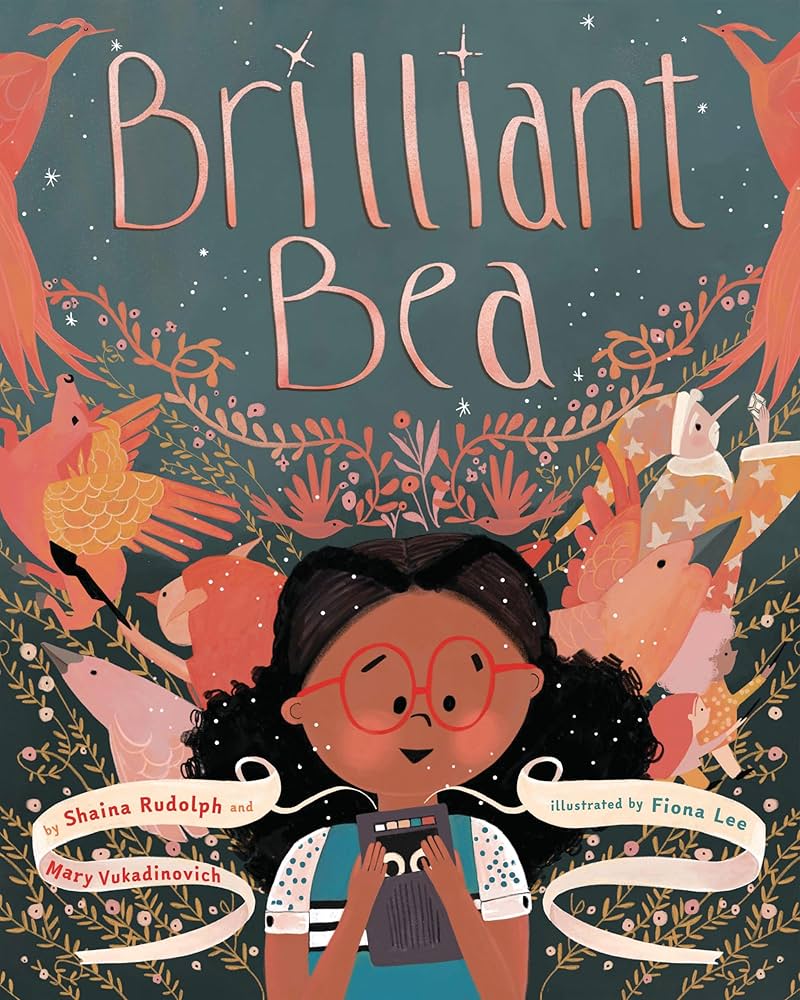
Brilliant Bea is a children’s book by Mary Vukadinovich and Shaina Rudolph, illustrated by Fiona Lee, about a girl with dyslexia who is a natural storyteller but struggles with reading and writing. With the help of a supportive teacher, Bea uses a tape recorder to speak her stories, discovering a new way to learn and share her creativity, proving that learning differences don’t define her. The book is set in a dyslexia-friendly font and includes an afterword with information about dyslexia for parents and educators.
Discussion Questions
- What makes Bea “brilliant”?
- What are some of her strengths?
- How does Bea experience the world differently from other kids?
- How do Bea’s classmates respond to her at the beginning of the story?
- How does that change?
- Why is it important to learn about how others see or experience the world?
- What does the story teach us about kindness and inclusion?
- How can small actions help someone feel more included or comfortable?
- Have you ever felt misunderstood? What helped you feel better?
- What are some ways we can support classmates or friends who may need extra help?
- Why is it important to celebrate differences instead of trying to make everyone the same?
- What would you say to Bea if she joined your class or community?
Activity: Perspective Practice (Role-Play for Inclusion)
Goal: Help students practice empathy and learn concrete ways to respond kindly and inclusively when someone experiences the world differently—like Bea.
Step-by-Step Directions
1. Set the Tone (2–3 minutes)
Say something like:
“In Brilliant Bea, we saw that people can experience sounds, sights, and social situations differently. Today we’re going to practice noticing how someone might feel and how we can respond in a kind, supportive way.”
Reminders:
- There are no “bad” feelings
- We don’t laugh at people—only support and learn
- We are practicing being includers
2. Model It First (3–5 minutes)
Act out a short scenario yourself (or with another adult/student).
Example:
- Cover your ears and look overwhelmed
Then ask: - “What do you notice?”
- “What might I be feeling?”
- “What could you do to help me?”
Write or say a few strong responses aloud:
- “I could ask if you’re okay.”
- “I could give you space.”
- “I could lower the noise.”
3. Small Group or Partner Role-Play (10–15 minutes)
- Put students in pairs or small groups
- Give each group one scenario at a time
- One student acts it out, the others respond
- Then switch roles
Encourage simple acting—no pressure for perfection
4. Group Reflection (5–10 minutes)
After a few rounds, bring everyone back together and ask:
- “What did you notice?”
- “What worked well?”
- “What was harder than you expected?”
Scenarios to Use
Keep these simple, relatable, and tied to Bea’s experiences:
Sensory & Environmental
- A student covers their ears during a loud activity
- Someone asks to turn down the lights or move away from bright light
- A student seems overwhelmed in a crowded or noisy space
Communication Differences
- Someone doesn’t make eye contact while talking
- A student takes longer to respond to a question
- Someone repeats a phrase or struggles to explain what they need
Social Situations
- A student is sitting alone during group work or lunch
- Someone doesn’t join a game right away
- A classmate prefers to do an activity a different way
Emotional Moments
- A student seems upset but doesn’t explain why
- Someone gets frustrated quickly during a task
- A peer needs a break and steps away from the group
Response Prompts for Students
Give students sentence starters to make this easier:
Noticing
- “I notice that you…”
- “It looks like you might be feeling…”
Offering Support
- “Do you want help or space?”
- “Is there something I can do?”
- “We can… (be quieter, wait, change this, sit with you)”
Including
- “Do you want to join us?”
- “We can do it your way too.”
- “We’ll go at your pace.”